

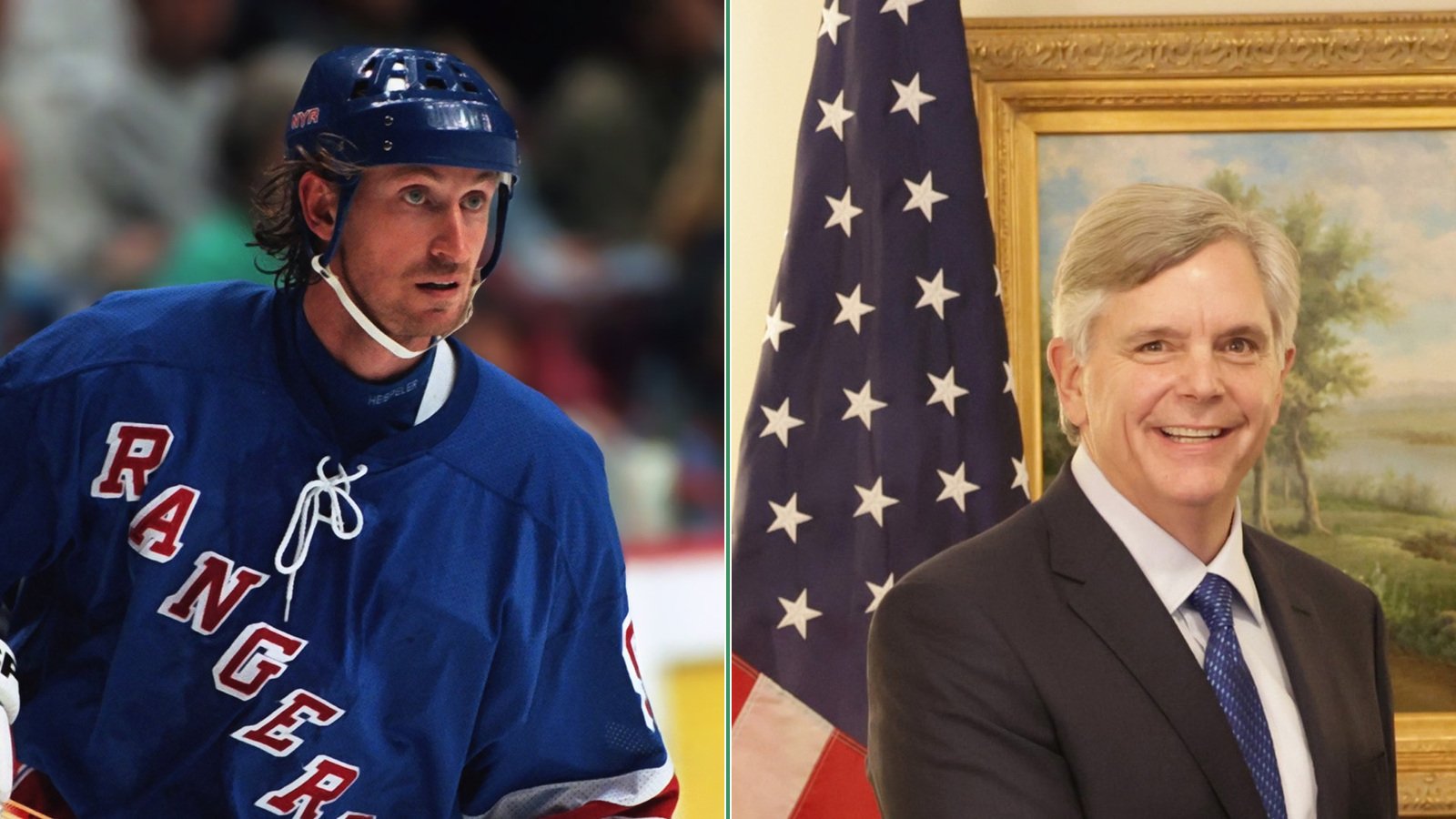
Wayne Gretzky built a record-setting hockey career before taking on coaching, ownership and national-team responsibilities. Larry Culp rose through Danaher’s operating businesses before leading GE’s transformation into three public companies. This side-by-side profile traces their separate achievements and the work that followed their early breakthroughs.
Gretzky’s journey from Brantford to the NHL
Gretzky grew up in Brantford, Ontario, practising on a backyard rink built by his father, Walter. His professional career began in 1978 with the Indianapolis Racers of the World Hockey Association, before he moved to Edmonton.
The Hockey Hall of Fame’s biography records four Stanley Cups with the Edmonton Oilers. A trade took him to the Los Angeles Kings in 1988, and he reached another Stanley Cup Final with Los Angeles in 1993, losing to Montreal.
His final NHL teams were the St. Louis Blues and New York Rangers. When he retired in 1999, he had played for four NHL franchises. The Racers belong to the earlier WHA chapter, separate from that four-team NHL record.
Gretzky’s scoring record goes beyond goals
The Hockey Hall of Fame’s records list 894 regular-season goals, 1,963 assists and 2,857 points. His playoff figures are separate: 122 goals and 260 assists, giving him 382 playoff points.
His biggest seasons show the range of that contribution. He scored 92 goals in 1981–82; in 1985–86, he recorded 163 assists and 215 points. A profile focused only on goals would leave much of his attacking play out of view.
Alex Ovechkin passed Gretzky’s regular-season goals total with his 895th goal on 6 April 2025.
A hockey career beyond playing
Gretzky entered the Hockey Hall of Fame in 1999 after it waived the normal three-year waiting period. Retirement also led to new responsibilities within the sport.


His official biography records spells as a minority owner and head coach of the Phoenix Coyotes, as well as his role as executive director of Canada’s gold-medal-winning men’s team at the 2002 Winter Olympics.
The 2002 Olympic gold belongs to a different chapter from his own scoring records: his responsibility was helping to assemble and organise Canada’s team. The Coyotes roles likewise involved coaching and ownership after his playing career. They are separate achievements and responsibilities, rather than an extension of his individual points total.
Culp’s progression through Danaher
Culp’s formal name in GE Aerospace’s leadership biography is H. Lawrence Culp, Jr. He earned an economics degree at Washington College and an MBA at Harvard Business School. He joined Danaher at Veeder-Root in 1990 and became that business’s president in 1993.
His responsibilities widened through successive appointments: group executive in 1995, executive vice president in 1999 and chief operating officer in 2000. He then served as Danaher’s president and CEO from 2001 to 2014. That route took him from running an individual business to overseeing broader operations and, eventually, the company.
In its April 2014 succession announcement, Danaher reported that revenue and market capitalisation had each increased approximately fivefold during Culp’s time as CEO, to nearly $20 billion and $50 billion respectively. These are the company’s measurements of growth across the organisation, not a calculation of value created by Culp alone.
Danaher linked the expansion to changes in its portfolio, its management team and the Danaher Business System. The company describes DBS as a continuous-improvement system: teams use data, measurable goals and repeated process changes to improve how work is done. That operating approach is a more concrete part of Culp’s history than a generic description of him as a turnaround executive.
Between his Danaher and GE chief-executive roles, Culp was a senior lecturer at Harvard Business School from 2015 to 2018 and a senior adviser at Bain Capital Private Equity from 2017 to 2018. GE’s biography describes his teaching focus as leadership, strategy and general management.
Taking responsibility for GE
Culp joined GE’s board in April 2018 and became CEO that October. He took on additional leadership of its aviation business in June 2022. By April 2024, he was chairman and CEO of the standalone GE Aerospace. The company’s leadership biography continued to list him in that role on 4 October 2026, alongside a separate position as non-executive chair of GE HealthCare.
How GE became GE Aerospace
Culp’s changing title reflects a restructuring of GE. GE HealthCare began trading separately in January 2023, followed by GE Vernova’s separation on 2 April 2024. GE Aerospace was left focused on aviation.
The stock symbols help distinguish the resulting companies in older and newer coverage. GE Aerospace retained “GE”, while GE Vernova began trading as “GEV”. Culp’s move from GE to GE Aerospace was part of that corporate separation, rather than a departure for an unrelated employer.
The standalone aviation company also had an established service business. In its launch communication, GE Aerospace said services accounted for 70 per cent of approximately $32 billion in adjusted 2023 revenue. The historical figure helps explain the business mix: supporting and maintaining engines, as well as producing them.
Making operating discipline concrete
In an April 2025 company-published interview, Culp described FLIGHT DECK, GE Aerospace’s lean operating model, with priorities ordered as safety, quality, delivery and cost.
He illustrated the approach through the supplier base. According to Culp, 15 priority supplier sites accounted for 80 per cent of material shortages at the start of 2024. The company deployed more than 550 engineering and supply-chain resources into its supplier base to work on problems together.
The example gives the management language a practical meaning: locate the concentrated problem and bring relevant expertise to it. It remains Culp’s account of the approach, rather than an independent assessment of its results.
A note on the 2022 conference reference
A Sports Business Journal report from 9 May 2022 mentioned Culp as a Milken Institute Global Conference attendee and, separately, a Gretzky-inspired analogy used by Coyotes executive Xavier Gutierrez. It did not report a Gretzky–Culp meeting or collaboration. The careers above are presented as separate profiles, without turning their co-occurrence in that report into a shared history.
Updated: 4 October 2026.
Photo credits: Håkan Dahlström (source edits: CillanXC; CC BY-SA 3.0, left panel); PM India (permitted reproduction). Cropped/resized.
