

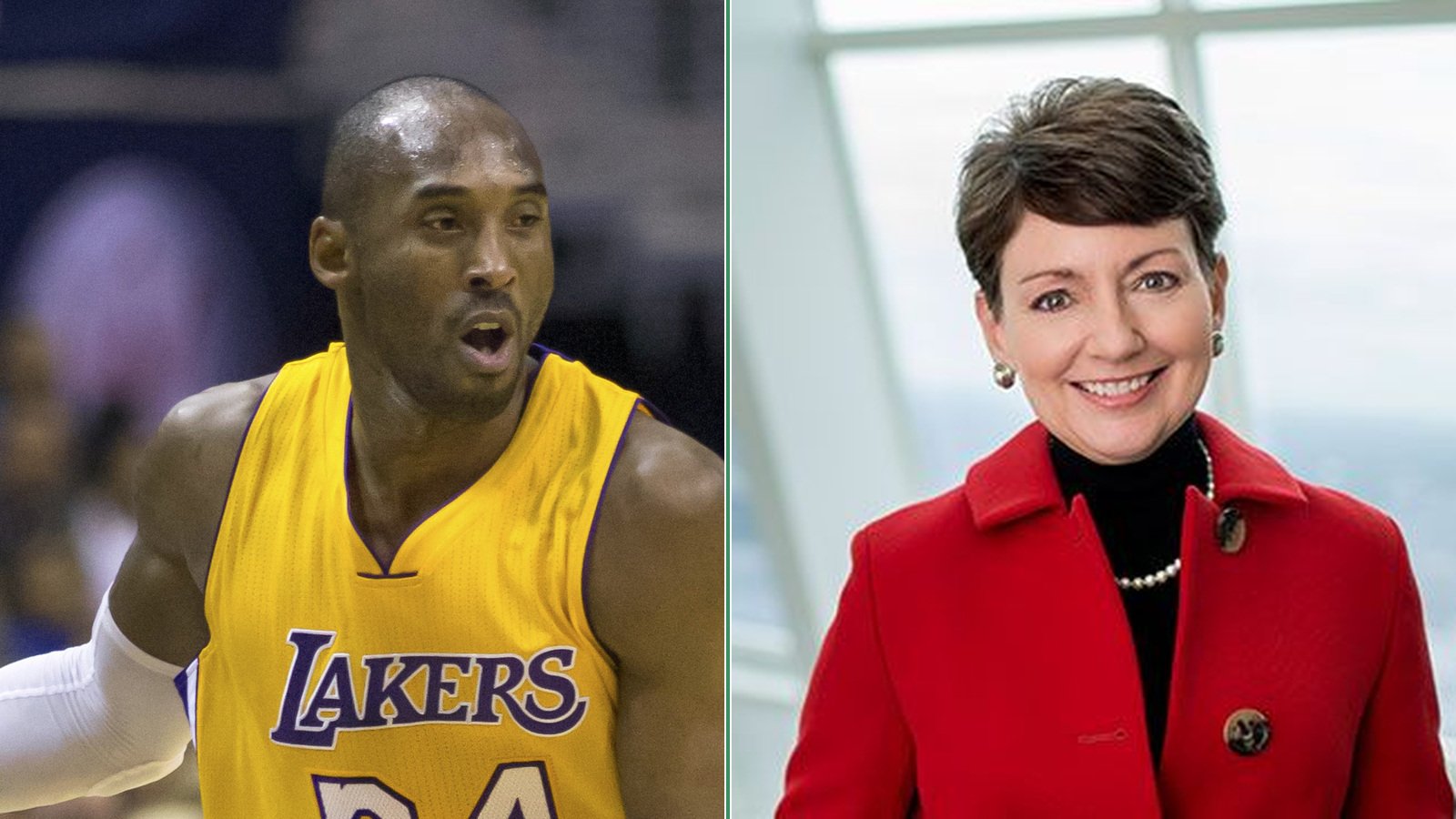
Kobe Bryant and Lynn Good are known for careers in basketball and the energy industry. Bryant spent 20 NBA seasons with the Los Angeles Lakers, winning five championships, and later shared an Academy Award for Dear Basketball. Good was Duke Energy’s CEO from 2013 until her retirement in April 2025.
These separate career profiles focus on what followed their early success: Bryant’s filmmaking, coaching and support for women’s basketball, and Good’s reshaping of Duke alongside the environmental obligations of running a major utility. The pairing is an editorial comparison, not a claim of a joint project or personal connection.
Kobe Bryant’s route to the Lakers
Bryant was born in Philadelphia on 23 August 1978, but spent much of his childhood in Italy. The NBA’s player profile explains that his father, Joe Bryant, played professional basketball there after his NBA career. Kobe lived in Italy from the age of six to 13, with his grandparents sending American basketball tapes to help him follow the game from abroad.
After the family returned to the United States, he attended Lower Merion High School in Pennsylvania. He entered the 1996 NBA draft without playing college basketball. The Charlotte Hornets selected him with the 13th pick and then traded him to Los Angeles: the Lakers were his only NBA playing team, but not the team that drafted him.
His first three championships came alongside Shaquille O’Neal, as the Lakers won consecutive titles in 2000, 2001 and 2002. Bryant won the regular-season MVP award for 2007–08, then added two more championships in 2009 and 2010. He was named Finals MVP on both occasions.
The numbers behind his basketball career
The NBA’s career summary records 33,643 regular-season points and 18 All-Star selections. Alongside his scoring, Bryant earned eleven All-NBA First Team selections and nine All-Defensive First Team selections. Those honours capture a broader career than a list of his highest-scoring games alone.


Two nights nevertheless stand out. On 22 January 2006, he scored 81 points against the Toronto Raptors. On 13 April 2016, he ended his playing career with 60 points as the Lakers beat the Utah Jazz 101–96. The farewell brought his 20-season association with the team to a close.
Bryant also won Olympic gold with the United States in 2008 and 2012. He died on 26 January 2020 and belongs to the Naismith Basketball Hall of Fame’s Class of 2020.
From a farewell poem to Dear Basketball
Bryant’s 2015 farewell poem became the animated short Dear Basketball, made with animator Glen Keane and composer John Williams. At the Academy Awards on 4 March 2018, Keane and Bryant were the named recipients of the animated short film Oscar. The film turned his retirement from basketball into a separate creative project.
Coaching and support for women’s basketball
Bryant’s post-playing work also remained close to the court. In its 2022 announcement of the Kobe & Gigi Bryant WNBA Advocacy Award, the WNBA described his mentoring and training of players across school, college and professional basketball, including WNBA players. He coached his daughter Gianna’s youth team and supported the NBA and WNBA’s Her Time to Play initiative for girls.
The award, first presented to Chris Paul, gives institutional recognition to that work. It adds a different dimension to Bryant’s later career: sharing skills with younger players and promoting opportunities in the women’s game, alongside the individual achievements recorded in his NBA statistics.
Lynn Good’s path from accounting to Duke Energy
Good earned degrees in systems analysis and accounting at Miami University, according to her Boeing biography. She held senior management and partner positions at Arthur Andersen and Deloitte & Touche before joining Cinergy, a Duke Energy predecessor company, in 2003.
Within Duke, she gained experience across both finance and operations. Before becoming chief financial officer, she led the Commercial Businesses organisation. Its remit included non-regulated generation in the Midwest, international operations, renewables, corporate development and mergers and acquisitions. She became executive vice president and CFO in July 2009.
Duke announced her appointment as president and CEO on 18 June 2013, effective from 1 July. She succeeded Jim Rogers, who initially remained chair; Good took on the chair position herself in 2016.
The titles did not all cover the same period. Boeing’s biography dates her Duke presidency to 2013–2024, her chief executive tenure to 2013–2025 and her chair tenure to 2016–2025. Keeping those dates separate makes the later leadership handover easier to follow.
What changed during Good’s leadership?
One consequential change was Duke’s move towards a fully regulated utility business. In October 2023, it completed the sale of its utility-scale Commercial Renewables business to Brookfield, describing the transaction as the final step in that transition.
The business sold was unregulated. Duke’s announcement also set out plans to invest in renewable generation within its regulated operations and improve the electricity grid. Selling that particular portfolio did not mean abandoning renewable energy. The company said the proceeds would strengthen its balance sheet and reduce the need for additional holding-company debt.
The coal-ash cleanup obligation
Duke’s responsibilities during Good’s tenure also included a substantial environmental cleanup. On 5 February 2020, North Carolina’s Department of Environmental Quality announced that a court had approved a consent order covering excavation of more than 80 million tons of coal ash. It involved Duke, the regulator, and community and environmental groups.
The regulator said excavated ash would be placed in lined landfills or recycled for beneficial use, with additional protective measures and monitoring at specified sites. The agreement illustrates the public-interest and regulatory demands on the company alongside its investment decisions. These were Duke’s corporate obligations; the order is not evidence of personal wrongdoing by Good.
Lynn Good’s retirement and board roles
Good retired from Duke’s management role on 1 April 2025. Her board retirement and the CEO/chair succession were set out in Duke’s transition announcement. Harry Sideris became CEO and joined the board, while Ted Craver became chair. Sideris retained the presidency, which he had held since April 2024. The handover separated the CEO and chair positions Good had held together.
Her professional activity extended beyond Duke. As of 4 October 2026, Boeing’s director biography listed her as a director since 2015, chair of its Compensation Committee and a member of its Audit Committee. It also listed directorships at Caterpillar and Morgan Stanley.
What the comparison shows
Bryant and Good each spent substantial periods with the organisation most associated with their name, but reached their central roles differently. Bryant moved directly from high school into professional basketball. Good built experience in accounting, operations and finance before becoming chief executive.
Their later work also took different forms. Bryant developed creative work and took on coaching and advocacy; Good’s retirement from Duke left a continuing record of board service elsewhere. Those transitions are the useful connection between the profiles: a career can extend beyond the role for which someone is best known, without simply repeating it.
Updated: 4 October 2026.
Photos: Keith Allison (source edits: JoeJohnson2; CC BY-SA 2.0, left panel); Duke Energy (news-media use). Cropped/resized.
