

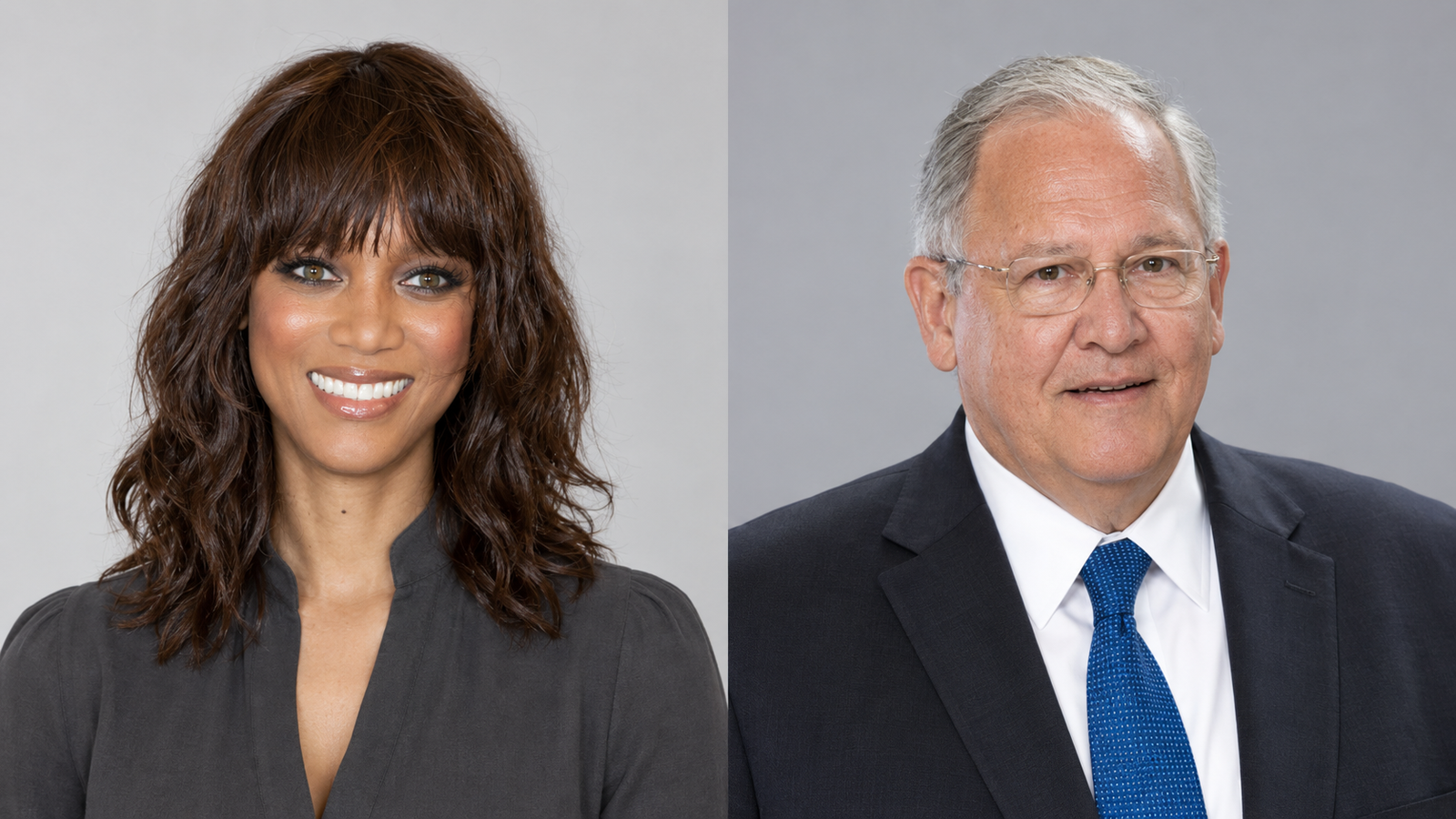
Tyra Banks and Greg Hayes took different routes into business leadership. Banks built on a career in modelling and television to create consumer businesses. Hayes worked through finance and senior management before leading United Technologies and RTX, the aerospace and defence group.
Image references: Tyra Banks by Digitas Photos, via Wikimedia Commons (CC BY 2.0), and Greg Hayes at Purdue’s 2024 Daniels Leads event. Transformed into an AI-generated portrait composite; the original Hayes photographer is not specified.
.jpg)
Greg Hayes here means Gregory J. Hayes, the former RTX chairman and chief executive. This is an editorial comparison of their separate careers, from creating television and consumer brands to managing a large industrial group; it does not imply a partnership.
Tyra Banks: taking an audience into a new business
Banks’s public profile had already reached major fashion milestones before her television businesses. Sports Illustrated’s own retrospective distinguishes her 1996 cover alongside Valeria Mazza from her 1997 solo cover, the first solo SI Swimsuit cover featuring a Black woman.
Creating and producing television
America’s Next Top Model began in 2003. Paramount’s official catalogue credits Banks as its creator and an executive producer. In a CBS interview before the UPN premiere on 20 May 2003, she discussed the work behind the programme, including preparation and editing. Her role extended beyond appearing on camera to helping build a repeatable television format.
The Tyra Banks Show followed in 2005 and ran until 2010. A 2008 Warner Bros. and CW announcement identified Banks as both host and executive producer, with production by Bankable Productions in association with Telepictures. It announced the programme’s move from first-run syndication to The CW for its fifth season in 2009.
The show won the Daytime Emmy for Outstanding Talk Show/Informative in 2008 and 2009. The original NATAS winners lists name Banks among the executive producers. These were awards for the programme, rather than wins in the separate talk-show-host category.
Learning to run businesses
In a 2016 Stanford Graduate School of Business account of her campus talk, she discussed the transition from modelling into producing programmes and running Tyra Beauty.
That talk offered a more practical picture of her approach than a list of endorsements. Banks described contacting people whose work she admired, including Zappos leader Tony Hsieh and author Adam Grant, to seek guidance. She also explained how she was learning to delegate instead of revising every detail herself. Those remarks describe her thinking at the time; they are not claims about the present status of Tyra Beauty.
Her Stanford connection also included teaching. Allison Kluger’s faculty biography identifies Project You: Building and Extending Your Personal Brand as a course she taught with Banks. Co-teaching that course was a distinct activity from giving a campus talk; it is not evidence that Banks earned a Stanford degree or currently holds a teaching appointment.
A later venture, SMiZE & DREAM, makes the personal connection especially visible. On the ice-cream company's official story page, Banks links the idea to childhood visits to an ice-cream shop with her mother. She says the business began during the pandemic and describes both the technical interest and daily work involved in running it.
The brand’s current official site also presents a Sydney flagship and an on-site flavour studio. These are concrete features of the business it advertises, while its profitability is not established by the founder’s story or public profile.
Greg Hayes: changing the shape of an established company
Hayes's route was through an existing corporation. According to his Phillips 66 board biography, he holds an economics degree from Purdue University and is a certified public accountant. He held senior roles across finance, corporate strategy and business development at United Technologies before becoming its chief executive in 2014.
BD’s 2025 announcement of his board appointment supplies an earlier step in that progression: Hayes joined UTC in 1999 through its merger with Sundstrand and served as chief financial officer from 2008 to 2014. His move to chief executive followed years overseeing the group’s finances.
His most consequential work involved changing what the company owned. RTX’s history of his tenure identifies the 2015 sale of Sikorsky Aircraft and the 2018 acquisition of Rockwell Collins. In 2020, Otis and Carrier were spun off, while UTC's remaining aerospace businesses combined with Raytheon Company.
The merger created Raytheon Technologies, subsequently known as RTX. Hayes was overseeing the reshaping of a diversified industrial group, with changes to its ownership and operating structure as well as its name.
The Pratt & Whitney inspection challenge
A major operating challenge during Hayes’s CEO tenure was the powder-metal issue affecting certain Pratt & Whitney engine parts. In a September 2023 disclosure, RTX said accelerated inspections of PW1100 geared-turbofan engines would mean additional maintenance visits and aircraft groundings. It estimated a multi-year pre-tax operating-profit impact of $3 billion to $3.5 billion.
The subsequent 2023 annual filing reported a $2.9 billion pre-tax charge recorded in the third quarter. That charge reflected estimated customer compensation and additional maintenance costs at Pratt’s share of the programme. It was an accounting recognition, not a statement that the final cost was settled or that the same sum had already been paid in cash. The figures describe a corporate operating problem; they do not establish personal culpability by Hayes.
Why his RTX title needs a date
Hayes should no longer be described as RTX's current chief executive. The company's February 2025 succession announcement records that Christopher Calio became president and CEO on 2 May 2024. Hayes moved to executive chairman on the same date.
Calio then became chairman on 30 April 2025. RTX said Hayes would serve as a special adviser to the CEO through 2 January 2026. That timetable should not be turned into an undated claim that Hayes still holds the advisory job.
The Phillips 66 biography checked on 4 October 2026 lists Hayes as its lead independent director and identifies his RTX roles in the past tense. It also lists a board role at Becton, Dickinson and Company. Leaving the RTX executive office therefore should not be confused with leaving corporate board work altogether.
What the comparison actually shows
Banks's account centres on attracting customers to a product associated with her own public identity. Hayes's record centres on choosing the businesses inside a large company and managing changes in its leadership and structure. Both stories involve commercial decisions, but they concern different responsibilities and different kinds of organisations.
Banks’s production credits, classroom work and consumer ventures show how she expanded the kinds of work she did. Hayes’s transactions and the engine-inspection programme show the strategic and operating demands of running an established corporation. Their records are more informative when those responsibilities are kept specific, without substituting celebrity or company size for demonstrated business results.
Updated: 4 October 2026.