

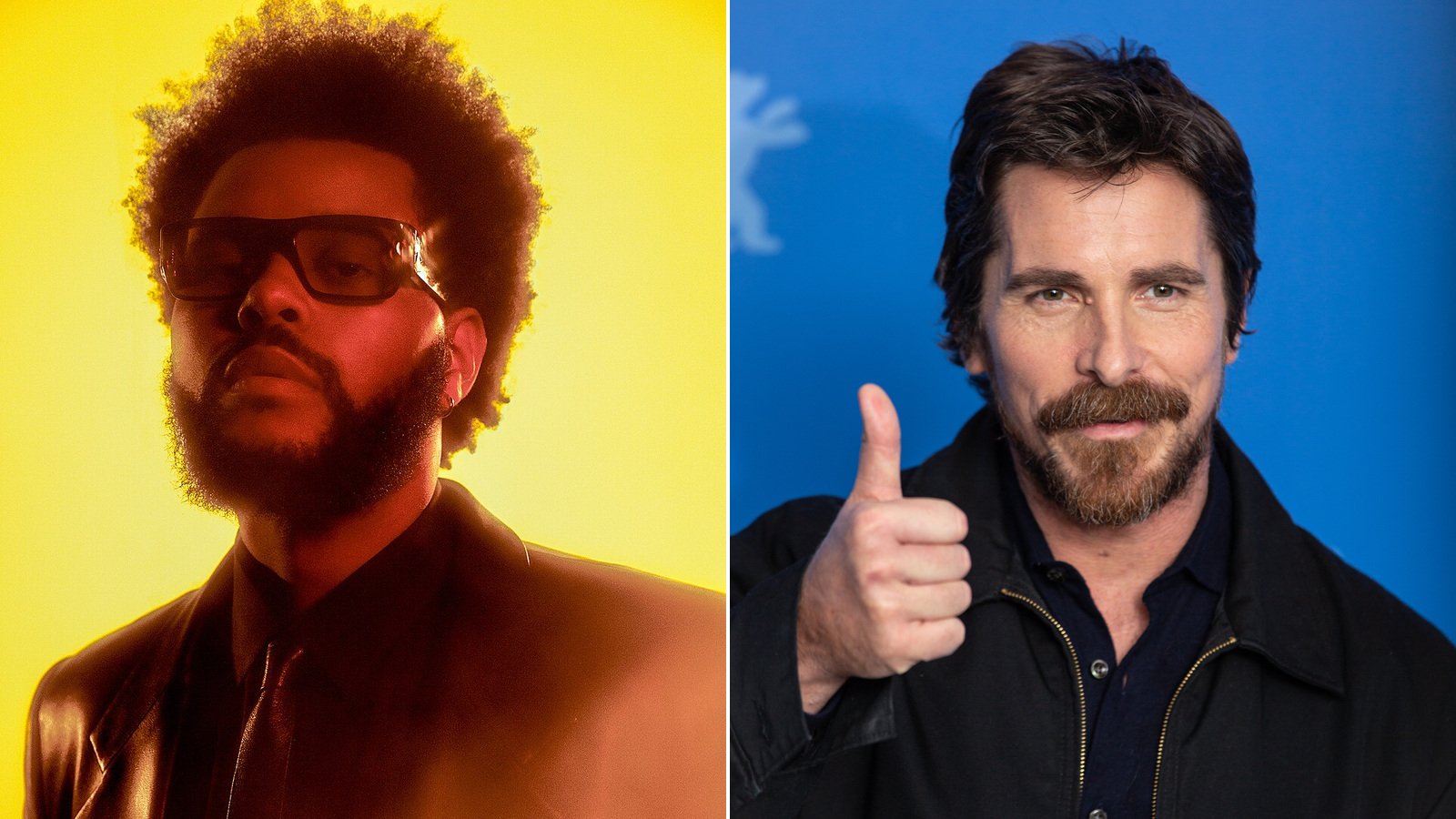
Photos: Brian Ziff & Harald Krichel · CC BY-SA 4.0. Source adjustment: User1042; layout/crop: MoNews.


A late-night television appearance becomes the doorway to The Weeknd’s nightmare. A business-card exchange sends Christian Bale’s Patrick Bateman into panic. Both performances take familiar rituals of success and make them unsettling.
The acting problems are different, though. The Weeknd carries a fictional identity into the public appearances where audiences expect to meet the real singer. Bale often plays characters who are themselves performing for other people: Bateman advertising his status, or Bruce Wayne pretending to be an empty-headed celebrity.
Looking closely at those choices produces a more useful comparison than describing both men as intense or mysterious. Their interviews reveal how the characters were built, what collaborators contributed and where resemblance ends and documented influence begins.
The Weeknd’s red suit: a story that followed him offstage
The Weeknd is the professional name of Canadian musician Abel Tesfaye. During the After Hours period, the distinction between a recording artist and a fictional protagonist became unusually visible. The red jacket stayed recognisable while the character’s appearance deteriorated.
In his 2021 GQ interview, Tesfaye described the character as a disturbing perspective on Hollywood and its effects. Crucially, he assigned that perspective to the role: “Not Abel’s, but The Weeknd’s.” The name on the record was also the name attached to a performance.
The After Hours short film makes that overlap concrete. Directed by Anton Tammi, it begins at Jimmy Kimmel Live!, drawing a real promotional booking into its fictional world. In GQ’s 2020 interview with Tammi, Tesfaye said the booking prompted his idea for the short. Leaving the television stage becomes part of the story, instead of a clean return to ordinary life.
The live-performance work had its own collaborators. Director Alex Lill told Pitchfork that ideas came from Tesfaye, creative director La Mar Taylor and himself. For the 2019 Colbert performance, the team built moving replica corridors; Lill also named Being John Malkovich as a reference. The apparently continuous world depended on sets, direction and coordination across separate productions.
A recurring costume is especially useful in this format. A viewer may encounter a music video, an awards performance and a magazine photograph days apart, in no guaranteed order. The red suit supplies an immediate recognition cue. Continuity no longer relies only on watching one film from beginning to end; it can accumulate through repeated encounters with the star.
Patrick Bateman: making the effort to look normal visible
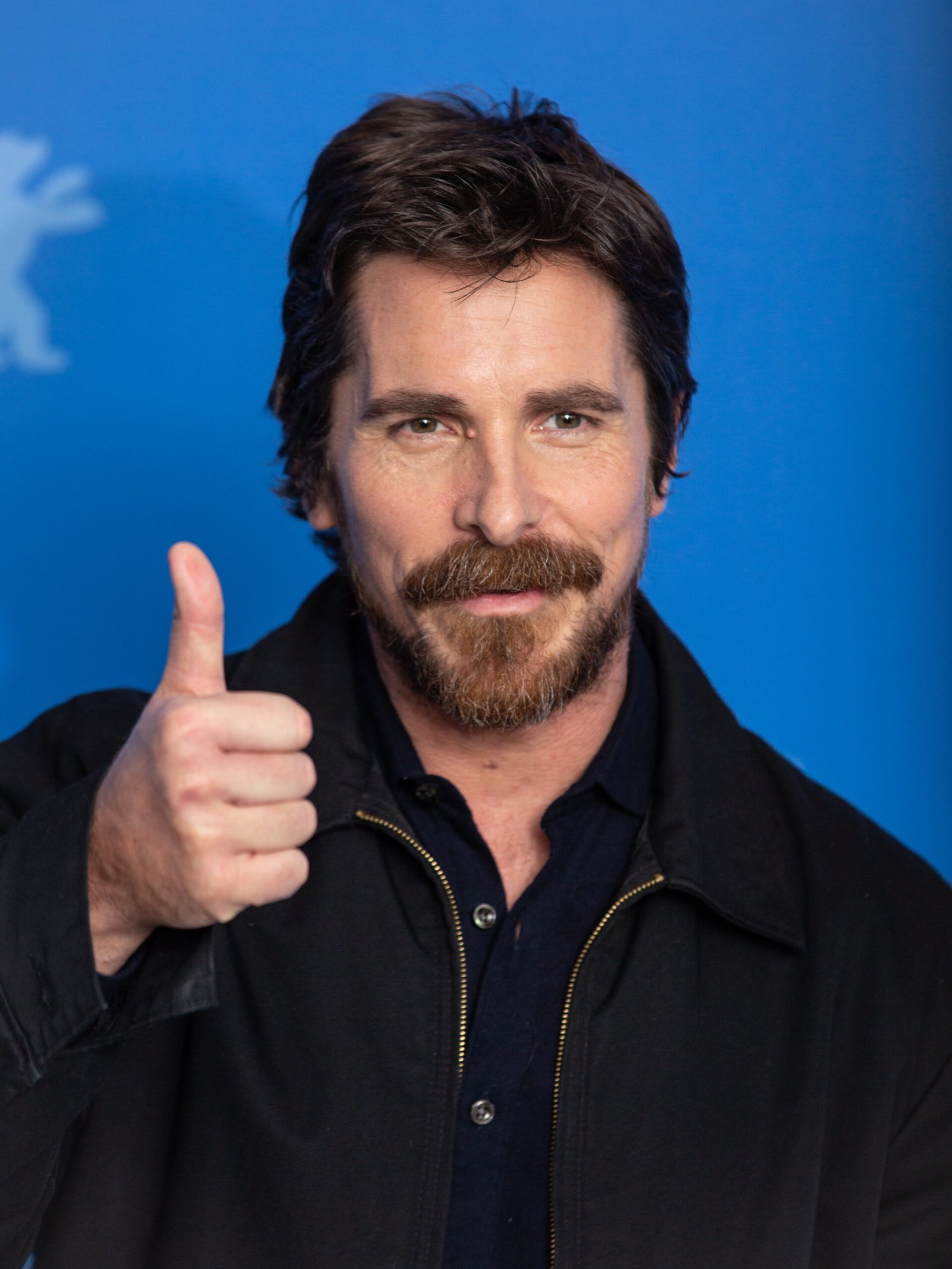
Bale’s Patrick Bateman presents a different kind of continuity problem. In American Psycho (2000), directed by Mary Harron and adapted by Harron and Guinevere Turner from Bret Easton Ellis’s novel, the character works obsessively to maintain a convincing exterior.
Harron explained in her contemporary Fresh Air interview that Bateman constructs an identity from the right clothes, possessions and restaurants. She and Bale approached him as someone imitating human behaviour. In a conventional naturalistic performance, visible effort can break the illusion. Here, the effort is part of the character.
The business-card scene demonstrates this without a chase or a murder. Bateman and his colleagues turn tiny differences in paper and typography into a hierarchy. The cards are mundane, but the stakes feel enormous to him. The comedy depends on the gap between the object’s importance to an ordinary viewer and its importance inside Bateman’s world.
Bale’s own account reinforces the comic intention. In GQ’s 2022 career interview, he recalled keeping Ellis’s novel beside him while working on scenes. He and Harron connected through their shared sense of the material’s humour, rather than through an elaborate explanation of Bateman’s childhood.
The photography helps sustain that approach. Speaking to American Cinematographer, Harron described wanting bright, crisp images and a composed visual surface. Cinematographer Andrzej Sekula explained the use of wide lenses and depth of field to keep the surroundings present. Unease could emerge inside an orderly space rather than depend on hiding everything in darkness.
This is where the comparison becomes revealing: After Hours makes damage increasingly visible, while Bateman tries to keep his surface intact. One character’s appearance unravels; the other’s effort to control appearances becomes the spectacle. That is a reading of the work, not a claim that Bale directly inspired Tesfaye’s persona.
Batman adds a third identity to the comparison
Bale’s Batman offers a more complicated example than a simple division between a real person and a disguise. Discussing Batman Begins with Blackfilm in 2005, he distinguished the troubled private Bruce Wayne, the threatening Batman and the deliberately vacuous playboy Wayne.
In that account, the private Wayne supplies the emotional reason for the other performances. Batman channels his anger; the celebrity playboy gives the public someone easy to dismiss. An uncovered face is therefore not necessarily the character’s most honest presentation. Bruce can be disguising himself without wearing the cowl.
The role continued through Nolan’s The Dark Knight (2008) and The Dark Knight Rises (2012). Across those films, the audience follows several versions of one man. With The Weeknd, the ambiguity works outside a single film as well: the professional identity attached to a song can also be the figure inhabiting its visual fiction.
The distinction gives viewers a practical question to ask: who is this performance intended to convince? Bateman wants recognition from his peers. Bruce’s playboy display is intended for Gotham’s public. The Weeknd’s recurring costume addresses an audience moving between music and apparently ordinary celebrity appearances. Similar tools are doing different narrative jobs.
The career context behind the characters
Tesfaye had been organising music into connected bodies of work long before After Hours. His three 2011 mixtapes, House of Balloons, Thursday and Echoes of Silence, became the basis of the 2012 compilation Trilogy. Universal’s original announcement describes the remixed and remastered collection, with three additional tracks.
That early sequence should not be confused with the later one. Hurry Up Tomorrow, released on 31 January 2025, completed the run of albums begun by After Hours in 2020 and continued by Dawn FM in 2022, according to the label’s release announcement. Following which chapter belongs to which project is more informative than treating every visual identity as a permanent change of personality.
Bale’s career offers a succession of separate assignments: Spielberg’s young protagonist in Empire of the Sun (1987), Laurie in Little Women (1994), and the insomniac Trevor Reznik in The Machinist (2004), among the roles documented by the BFI. His portrayal of Dicky Eklund in The Fighter won the 2011 supporting-actor Oscar. The different people are the point; the career cannot be reduced to Bateman or Batman.
Their work also reached different categories at the 2016 Oscars: Bale was nominated for supporting actor for The Big Short, while The Weeknd shared the original-song nomination for “Earned It” with Ahmad Balshe, Jason Quenneville and Stephan Moccio. Neither won those categories. It is a useful date in their careers, rather than evidence of a creative partnership.


What changes when The Weeknd becomes a film actor?
Tesfaye’s acting work has moved through several relationships with his public identity. In the Safdie brothers’ Uncut Gems (2019), he appeared as a version of himself, as the contemporary BFI cast record documents. In The Idol (2023), he played a separately named character, Tedros, opposite Lily-Rose Depp’s Jocelyn. HBO’s credits also identify him as a co-creator alongside Sam Levinson and Reza Fahim.
The 2025 film Hurry Up Tomorrow returned to a fictionalised musician, this time in a leading role alongside Jenna Ortega and Barry Keoghan. The premise uses a loss of the singer’s voice to begin a destabilising journey. Yet being the recognisable figure at its centre did not mean doing every creative job.
In his joint interview with director Trey Edward Shults, Tesfaye described providing material and discussing the script, then letting Shults shape the film so he could concentrate on performing. He also said Shults had asked him to study Ingmar Bergman’s Persona. That specific exchange establishes an influence and who introduced it.
Bale’s work with Scott Cooper provides a useful comparison on preparation. For The Pale Blue Eye, which reached Netflix in January 2023, he played detective Augustus Landor opposite Harry Melling’s Edgar Allan Poe. Cooper described extensive script and motivation discussions before filming. Character work here is a shared understanding developed before a take, not just something visible in makeup or costume.
The two accounts replace a familiar myth about transformation with a more practical picture. There is source material to interpret, a director’s approach to understand and other actors to respond to. A music persona can bring a ready-made audience into a film, but an audience’s recognition does not resolve those acting tasks.
Their work in 2026
In 2026, Bale played Frankenstein in Maggie Gyllenhaal’s The Bride!. The official synopsis places the story in 1930s Chicago, with Jessie Buckley as the Bride. By the October research date, the film’s website advertised digital availability. It is another transformation into an existing fictional figure, within a new filmmaker’s interpretation.
For Tesfaye, completing an album sequence did not settle the future of his professional name. On 6 October 2026, Live Nation’s official listings still advertised upcoming After Hours Til Dawn shows under The Weeknd name, including Hong Kong dates later that month.
The enduring contrast is therefore about where the character lives. Bale’s roles are usually contained within a film’s world, even when they explore public disguises. The Weeknd’s persona can occupy the space between the music, its fiction and the public appearance. Understanding that boundary makes both more interesting to watch: the familiar face is only the beginning of the performance.
Information checked: 6 October 2026.