


Featured image: separate portraits of Nelson Peltz (left), via Unilever, and Amancio Ortega (right), via Inditex. Composite: MoNews.
Nelson Peltz has built influence by investing in established companies and pressing for change. Amancio Ortega built the business behind Zara and retained a controlling interest. Their separate careers answer a revealing business question: how much power comes from the shares someone owns, and how much must be won from other people?
Updated: 6 October 2026. Ownership figures and historical appointments are dated below.
Peltz is chief executive and a founding partner of Trian Fund Management. Ortega is Inditex’s founder and controlling shareholder. Comparing them brings two sources of authority into focus: shareholder persuasion and enduring ownership. Yet neither career fits neatly into one category. Peltz was an operator before becoming an activist, while Ortega’s investments extend beyond the retailer he founded.
A board seat and a controlling stake confer different powers
Two dated disclosures show the distinction. When Unilever announced Peltz’s board appointment in May 2022, it said Trian-managed funds held interests in approximately 1.5% of its share capital. Inditex’s 2025 governance report records Ortega’s indirect holding at 59.294% of shares and voting rights on 31 January 2026, through Pontegadea Inversiones and Partler Participaciones.
The figures describe different companies and dates, but the underlying contrast is clear. A minority shareholder needs support to secure changes the board resists. A controlling shareholder begins with a majority voting position. A board seat, meanwhile, gives its holder a place in collective oversight; it does not make that director the chief executive.
Unilever’s current leadership directory lists Peltz as a non-executive director. His appointment illustrates how experience and an agreed relationship with a board can turn a minority investment into formal influence. The historical 1.5% figure should not be mistaken for Trian’s current holding.
Nelson Peltz: the operator behind the activist

Peltz joined his family’s food business in 1963. He later led Triangle Industries, the packaging company, as chairman and chief executive from 1983 until its acquisition in December 1988. He held the same executive roles at Triarc from April 1993 to June 2007, a period when its businesses included Arby’s and the Snapple Beverage Group. Unilever’s appointment disclosure records this operating background.
Trian was formed in 2005, with Peltz as a founding partner and CEO. Its stated approach is to invest in companies with unrealised potential and work with their leadership teams. The practical question is how that engagement changes decisions. P&G and Disney provide contrasting answers.
P&G: gaining access through negotiation
The disagreement at P&G concerned how a large consumer-goods business should be organised. In its September 2017 proposal, Trian advocated three standalone business units beneath a lean holding company, with clearer regional responsibility for profits and losses. It argued that this would speed decisions and improve responsiveness to local customers. P&G countered that a similar structure would increase costs and add management complexity. These were competing arguments about organisation, not established outcomes.
The 2017 P&G contest did not end with a straightforward election victory for Peltz. The certified count elected all 11 company nominees, including Ernesto Zedillo, whose result against Peltz was exceptionally close. P&G then appointed Peltz separately, effective 1 March 2018, following discussions prompted by his substantial shareholder support.
The company’s shareholder letter also explained the strategic ground reached in those talks. It said the parties were not predisposed to excessive borrowing, major reductions in research spending or a break-up. The appointment therefore involved both board access and an understanding about the direction of the business.
The campaign created pressure; negotiation determined how Peltz would participate. He later decided not to seek re-election in 2021. His time on the board is documented, but attributing the company’s subsequent performance to him alone would require evidence beyond appointment dates and management endorsements.
Disney: a campaign can lose at the ballot box
At Disney’s April 2024 meeting, shareholders elected all 12 company nominees rather than Peltz or fellow Trian candidate Jay Rasulo. The final certified filing confirms the result.
A proxy contest asks shareholders to back competing board candidates, often by submitting voting instructions before the meeting. Disney illustrates the decisive constraint: owning shares and proposing changes do not guarantee a seat. For a minority activist, the argument must win support beyond the investor’s own votes.
Titles also change independently of investment interests. Wendy’s named Arthur Winkleblack chairman in September 2024, succeeding Peltz, who received the honorary title chairman emeritus. Older descriptions of Peltz as its serving chairman are consequently out of date.
Amancio Ortega: building a business around customer response
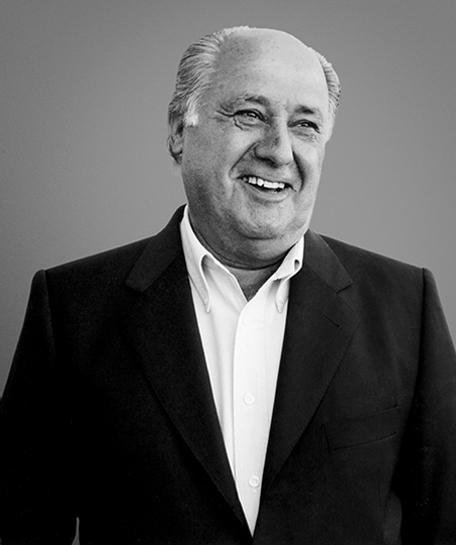
Ortega’s first clothing business also dates to 1963. The first Zara shop opened in A Coruña on 9 May 1975, a date documented in the account of its 50th-anniversary refurbishment. Moving from garment production into shops brought the business closer to the people buying its products.
Inditex’s 2025 annual report shows how that connection operates at scale. Sales analysis and daily feedback from stores inform product decisions. Short production runs and substantial sourcing near its Spanish headquarters provide flexibility. Central logistics hubs distribute goods to stores and online warehouses.
The advantage depends on the connections between those activities. Customer information has limited value if production cannot respond; responsive production has limited value if distribution cannot get the goods to shoppers. The retail business Ortega founded now depends on that relationship. Keeping it effective is now an organisational responsibility, involving designers, buying teams, suppliers, logistics specialists and store staff.
There is a practical commercial trade-off. Committing too much stock before demand is understood increases the risk of unsold goods and markdowns. Responding too slowly risks missing sales. A flexible system aims to manage both problems. It is an operating mechanism that can be examined through inventory, margins and cash generation, rather than explained by a founder’s reputation alone.
For a current sense of scale, Inditex reported approximately €19.8 billion in sales and €3.0 billion in net income for the six months from February to July 2026. These are results of the whole group, not Ortega’s personal income.
Succession without giving up control
Inditex listed on Spanish stock markets on 23 May 2001. Public shareholders joined the ownership structure while Ortega retained control. His later departure from the chairmanship in 2011 was another distinct transition: leaving a leadership position did not mean selling the controlling stake.
Marta Ortega Pérez has been non-executive chair since April 2022. Óscar García Maceiras is CEO, and Amancio Ortega remains a non-executive proprietary director, the category for a director associated with a significant shareholder. These responsibilities are set out in the governance report; the September 2026 interim statements confirm the three board positions.
The arrangement separates ownership continuity, board leadership and executive management. It also gives the comparison with Peltz a sharper focus. An activist’s board involvement may begin and end around a particular investment campaign. Ortega’s influence has survived changes in who chairs and manages the company because its foundation is his continuing ownership.
Both careers extend beyond the familiar labels
Trian’s Janus Henderson investment became a private-ownership deal
Trian first invested in Janus Henderson in 2020. On 30 June 2026, the asset manager announced that its take-private transaction with Trian, General Catalyst and Qatar Investment Authority had completed. Shares not already owned or controlled by Trian became rights to US$52 each in cash, and the ordinary shares were delisted from the New York Stock Exchange. Ali Dibadj continued as CEO, according to the closing announcement.
That progression from 2020 to 2026 challenges the idea that activism must mean a brief intervention followed by an exit. Here, involvement developed into private ownership alongside other investors. It also shows why the transaction’s structure matters more than the investor’s label: participating in a buyout brings different responsibilities from asking public shareholders for a few board seats.
Ortega’s investment company has taken minority positions elsewhere
Ortega’s role as an investor is broader than holding Inditex shares. In November 2021, Repsol announced that Pontegadea, which it identified as the investment firm chaired by Ortega, was investing €245 million for 49% of its Delta wind farm. The agreement announcement described Pontegadea’s first renewable-energy transaction.
This was a minority investment in a specific operating asset, alongside its existing owner. It was separate from Ortega’s control of Inditex and was not an activist board campaign. The example matters because a founder can retain control of one business while deploying capital through different ownership arrangements elsewhere.
What their careers really show about corporate influence
The contrast is strongest when expressed through three concrete questions.
- Who must agree? Peltz’s P&G and Disney experiences turned on negotiations and support beyond Trian’s own investment. Ortega’s Inditex position starts with a controlling vote, making the quality of independent oversight particularly important.
- What is being changed? An activist seeks to alter decisions at an existing company. A founder can shape the operating model from its beginnings. Either way, proposals have to become actions inside the business before they can affect performance.
- How does influence persist? Ortega retained ownership through leadership changes. Trian’s Janus Henderson involvement developed into a buyout. These cases show why a long-term founder and a short-term activist are unreliable automatic opposites.
Inditex’s 2025 governance report recorded five independent directors on its ten-member board. That supplies a useful counterweight to the ownership story: a controlling interest and independent scrutiny can coexist. Equally, the result of one shareholder election is only one part of evaluating an activist’s argument.
The comparison ultimately concerns who can turn an idea into a corporate decision. Peltz’s record shows influence assembled through investment, negotiation and changing ownership structures. Ortega’s shows an operating business built over decades, with control retained as executive responsibilities passed to others. Neither a wealth ranking nor a job title captures those differences.
For the executive-management side of the subject, see MoNews’s comparison of David Lawler and Bruce Broussard’s routes to the CEO’s office.