

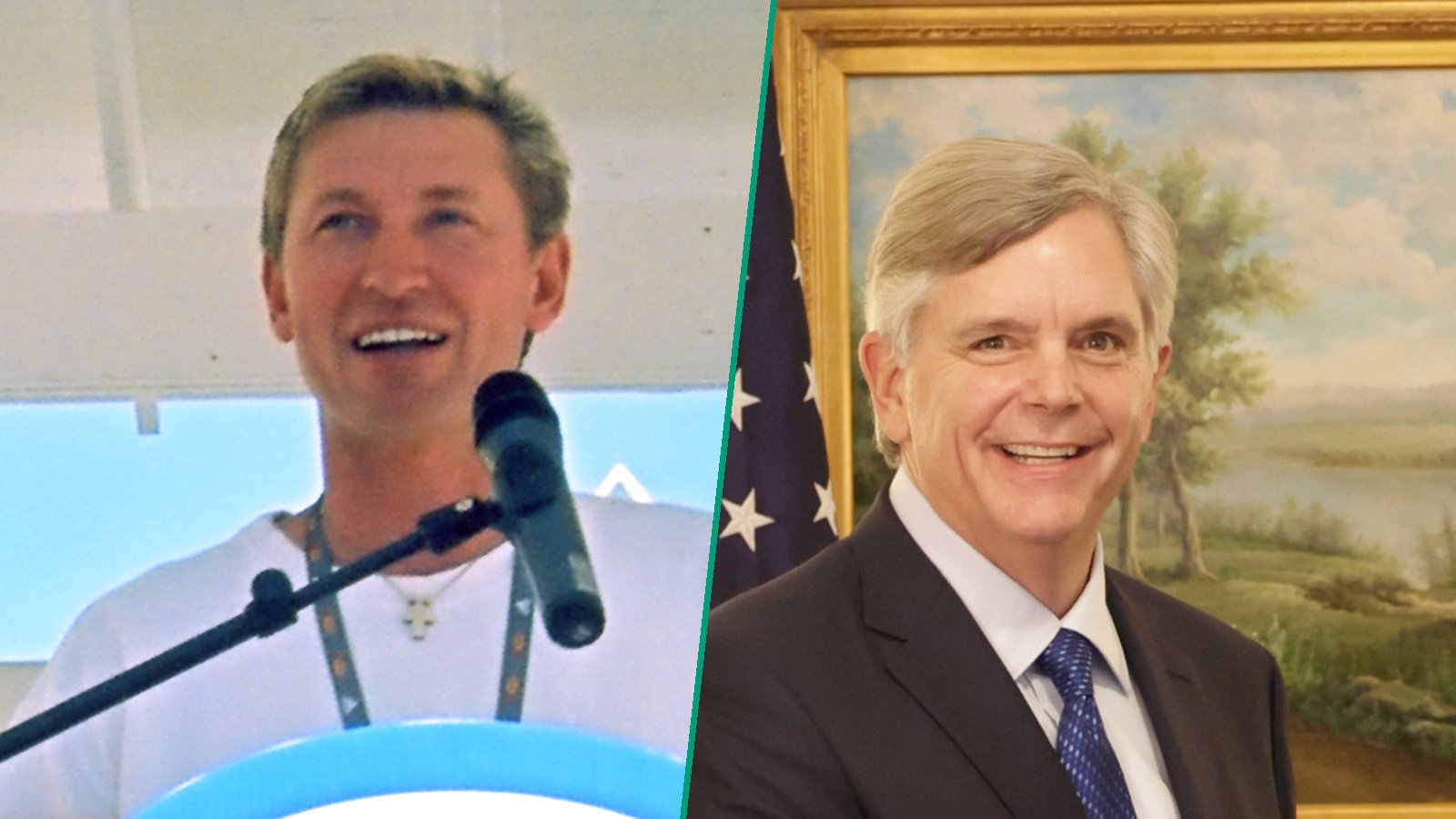
Wayne Gretzky and Larry Culp appear in the same 2022 conference report, but for different reasons. Culp was among the business leaders attending. Gretzky entered the story through a hockey analogy used by another speaker, rather than through a reported meeting with Culp.
Beyond that reference are two substantial careers: Gretzky’s achievements as a player and his later involvement in hockey, and Culp’s progression through Danaher, GE and GE Aerospace.
What the 2022 conference report actually says
A Sports Business Journal report published on 9 May 2022 covered discussions at the Milken Institute Global Conference. Journalist Chris Smith named Culp, then GE’s CEO, among the prominent attendees.
In another part of the report, Arizona Coyotes president and CEO Xavier Gutierrez used a Gretzky-inspired analogy about anticipating where the puck would go. His subject was the opportunity for sports businesses to connect with growing audiences. The reference came from Gutierrez, not from Culp or a joint presentation by Gretzky and Culp.
Milken’s programme records add useful context. Culp appeared in a session about technologies shaping the future of energy. Gutierrez was listed in a separate sports-and-entertainment discussion about inclusion. The two sessions help explain the range of subjects covered by the conference report.
That is the documented overlap: a business executive attending the event and a famous hockey player invoked in a speaker’s analogy. The article does not describe the two working together.
Gretzky’s route through professional hockey
Gretzky grew up in Brantford, Ontario, practising on a backyard rink built by his father, Walter. His official biography describes a professional career that began with the World Hockey Association’s Indianapolis Racers in 1978, before his move to Edmonton.
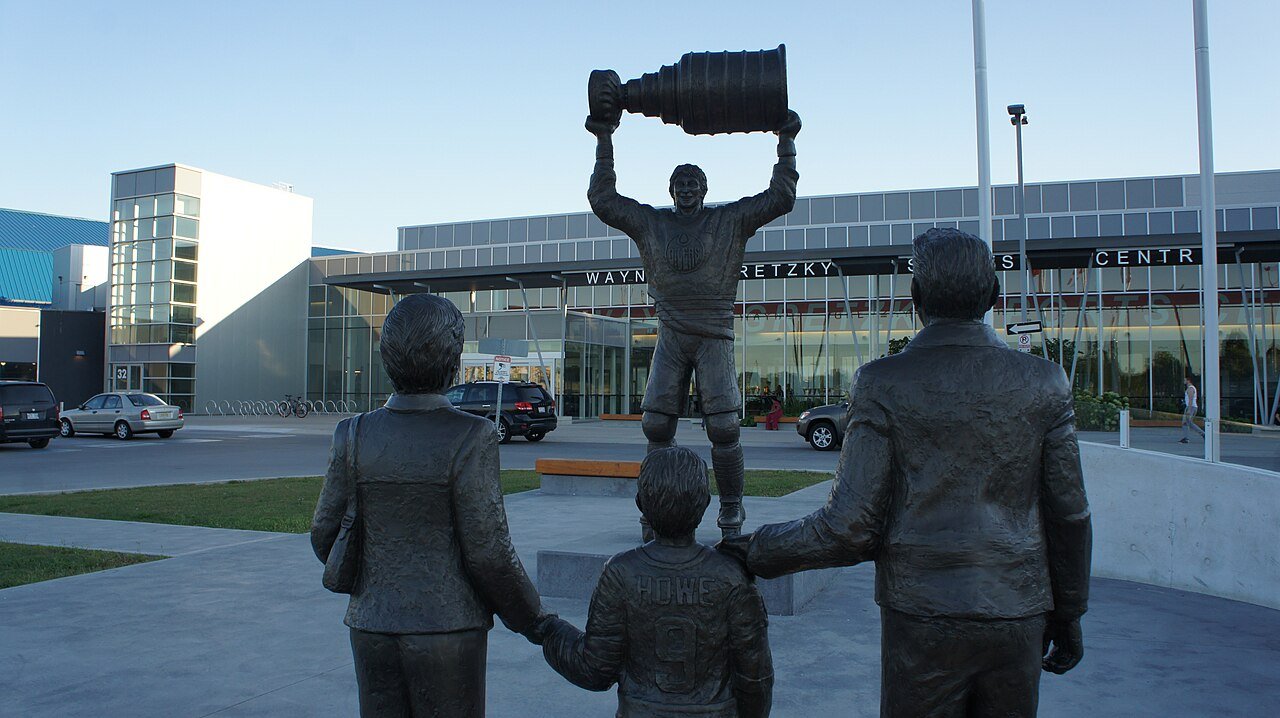
Edmonton became the centre of his most successful championship years. Gretzky won four Stanley Cups with the Oilers. In 1988, he was traded to the Los Angeles Kings; in 1993, he reached another Stanley Cup Final with Los Angeles, which lost to Montreal.
His final NHL stops were the St. Louis Blues and New York Rangers. He retired in 1999, having played for four NHL franchises. That sequence matters because his career was not a single uninterrupted spell with one team: his achievements stretched across different organisations and phases of the sport.
What his scoring record reveals
The Hockey Hall of Fame’s records and honours list 894 regular-season goals, 1,963 assists and 2,857 points. His playoff record adds another 122 goals and 260 assists, for 382 points. Those playoff totals are separate from the regular-season figures.
His season-by-season peaks show both sides of his attacking game. In 1981–82 he scored 92 goals. In 1985–86 he produced 163 assists and 215 points. Counting only goals would miss much of the contribution captured by that record.
Put another way, assists account for roughly 69 per cent of his regular-season points, calculated from the Hall of Fame totals. That proportion gives readers a simple way to see the balance between finishing moves and helping teammates score. It is not a complete measure of his play, but it explains why his passing belongs at the centre of any account of his career.
Alex Ovechkin passed Gretzky’s regular-season goals total with his 895th goal on 6 April 2025.
The years after playing
The Hall of Fame waived its normal three-year waiting period for Gretzky’s induction in 1999. His involvement in the sport continued after retirement: his official biography records roles as a minority owner and head coach of the Phoenix Coyotes, and as executive director of Canada’s gold-medal-winning men’s team at the 2002 Winter Olympics.
Those roles widened his responsibilities from playing to coaching, ownership and team organisation. They are a useful reminder that a sporting career can have several professional chapters. The skills and authority involved in each role also differ, even when the same person moves between them.
Larry Culp’s progression at Danaher
Larry Culp is formally listed as H. Lawrence Culp, Jr. GE Aerospace’s leadership biography identifies him as its chairman and CEO and records an economics degree from Washington College and an MBA from Harvard Business School.
He joined Danaher at Veeder-Root in 1990 and became that business’s president in 1993. Further promotions included group executive in 1995, executive vice president in 1999 and chief operating officer in 2000. He served as Danaher’s president and CEO from 2001 to 2014.
That progression shows the steps behind the chief-executive title: responsibility for a business, then a broader group, then company-wide operations. It provides more context than describing him simply as a former Danaher CEO.
Culp joined GE’s board in April 2018 and became its CEO that October. In June 2022, he took on additional leadership of the aviation business. By April 2024, he was chairman and CEO of the standalone GE Aerospace.
Why GE became GE Aerospace
The change in title followed a restructuring of the company, rather than a straightforward move to an unrelated employer. GE HealthCare began trading separately in January 2023. GE Vernova’s separation followed on 2 April 2024, leaving GE Aerospace focused on aviation.
GE’s shareholder information distinguishes the three businesses and their market identities. GE Aerospace retained the “GE” stock symbol; GE Vernova began trading as “GEV”. For readers comparing older and newer coverage, the important point is the change in the organisation underneath the executive title.
The aviation business also began its standalone life with an established service operation. In its launch communication, GE Aerospace said services accounted for 70 per cent of its approximately $32 billion in 2023 revenue. That historical figure helps explain why the business involves maintaining and supporting engines as well as producing them.
What Culp means by operating discipline
In an April 2025 company-published interview, Culp described FLIGHT DECK, GE Aerospace’s lean operating model. He set its priorities in order: safety, quality, delivery and cost.
He also gave a specific supplier example. According to Culp, the company found that 15 priority supplier sites accounted for 80 per cent of its material shortages at the start of 2024. It deployed more than 550 engineering and supply-chain resources into its supplier base to work on problems together.
The example makes his management language concrete: identify where a constraint is concentrated, put relevant people around it and work on the underlying causes. It is Culp’s account of the approach, rather than a claim that every subsequent business result can be credited to one executive.
A useful comparison of teamwork
Gretzky’s assists record and Culp’s supplier example both draw attention to performance that depends on other people. For Gretzky, a pass contributes to a teammate’s scoring opportunity. In Culp’s example, engineers and suppliers work across organisational boundaries to address a production constraint.
The similarities are useful at that level of explanation. The responsibilities remain different: a player makes decisions during a game, while an executive shapes priorities and coordinates an organisation whose work unfolds over much longer periods.
Updated: 2 October 2026.
Photo credits
Featured photographs: Wayne Gretzky: Kmf164 / Aude, with source edits by Maurilbert and Soerfm, via Wikimedia Commons, CC BY-SA 2.5. The photograph was cropped and resized; the adapted Gretzky panel remains under CC BY-SA 2.5.

Larry Culp photograph: Source: Prime Minister’s Office, Government of India / pmindia.gov.in. Cropped and resized from a June 2023 photograph; reproduced under PM India’s accurate-reproduction permission. This separate panel is not covered by the Gretzky panel’s Creative Commons licence. The photographs were combined in separate panels and do not depict a shared event.
Inline photograph: Jfvoll, via Wikimedia Commons, CC BY-SA 4.0. Full source thumbnail reproduced unchanged.
